

Introduction
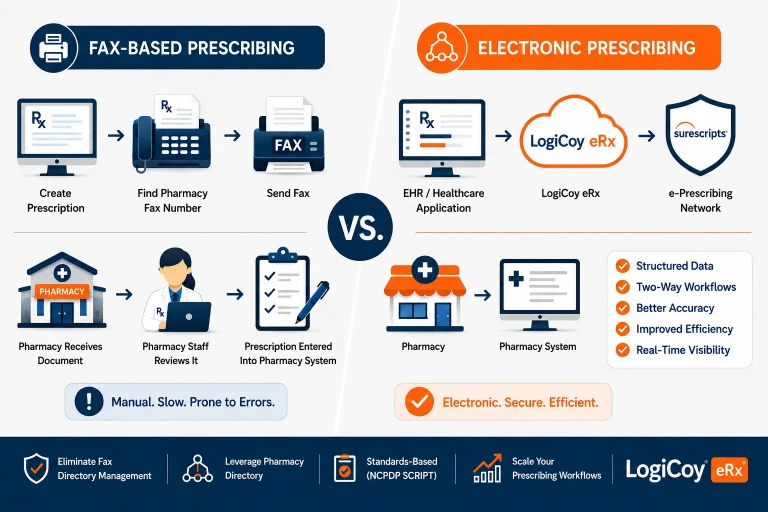
Fax is not the same as standards-based electronic prescribing. Fax transmits prescription information as a document or image, while electronic prescribing exchanges structured prescription information electronically between healthcare systems using standardized transactions.
For many healthcare applications, the difference is more than technical. A fax-based workflow can require pharmacy fax numbers, document generation, manual processing, and follow-up phone calls or faxes. An eRx API can replace that document-centric workflow with electronic prescription transactions and pharmacy connectivity.
This article explains the difference between fax and electronic prescribing, why some healthcare organizations continue to use fax, and how EHRs, telehealth platforms, digital health companies, and other healthcare applications can replace fax-based prescriptions with an eRx. Learn more about LogiCoy eRx integrations and cloud-based e-prescribing.
This guide is for: EHR/EMR vendors, telehealth platforms, healthcare SaaS companies and digital health applications that currently send prescriptions to pharmacies by fax.
Key Takeaways
- Fax is not standards-based electronic prescribing. Fax transmits prescription information as a document or image, while e-prescribing exchanges structured data between systems.
- Fax-based prescribing can create pharmacy-directory maintenance work. Applications may need to maintain accurate pharmacy fax information to route prescriptions.
- eRx APIs provide structured electronic connectivity. Healthcare applications can connect to an eRx platform instead of building their own fax-based pharmacy communication workflow.
- NCPDP SCRIPT is a major e-prescribing transaction standard. SCRIPT 2023011 is the current standard named in the CMS/ONC framework for the January 1, 2028 compliance date.
- LogiCoy eRx provides various integration options such as LogiCoy eRx web app integration, REST and FHIR R5 APIs. The platform is designed for EHRs, telehealth platforms and other healthcare applications.
What Is Fax-Based Prescribing?
Fax-based prescribing is the transmission of prescription information to a pharmacy as a faxed document or image.
The prescription may originate in a modern EHR or healthcare application. The application can generate the prescription electronically, but if it ultimately converts the prescription into a document and sends it by fax, the pharmacy receives a document rather than a structured electronic prescription transaction.
An electronic fax service can make the transmission itself digital, but that does not change the fundamental workflow. The prescription is still being communicated as a document rather than as a structured e-prescribing transaction.
This distinction matters because electronic prescribing is designed for computer-to-computer communication between prescribers, pharmacies, and other participants in the prescription workflow.
Is Fax Considered Electronic Prescribing?
No. Fax is not considered standards-based electronic prescribing.
CMS defines electronic prescribing as secure electronic, computer-to-computer transfer of prescription data. CMS specifically identifies facsimile transactions as not being electronic prescribing. See the CMS Electronic Prescribing program overview for more detail.
This does not mean that fax is prohibited for every prescription or every situation. Federal and state requirements can permit fax in specific circumstances and for certain workflows.
The important distinction is therefore not simply whether information travels electronically. It is how the prescription information is exchanged.
A fax transmits a document or image. Standards-based electronic prescribing transmits structured prescription information through defined electronic transactions.
Fax vs. Electronic Prescribing: How the Workflows Differ
The difference becomes clearer when the two workflows are compared.
Fax-based workflow
A typical fax workflow may look like:
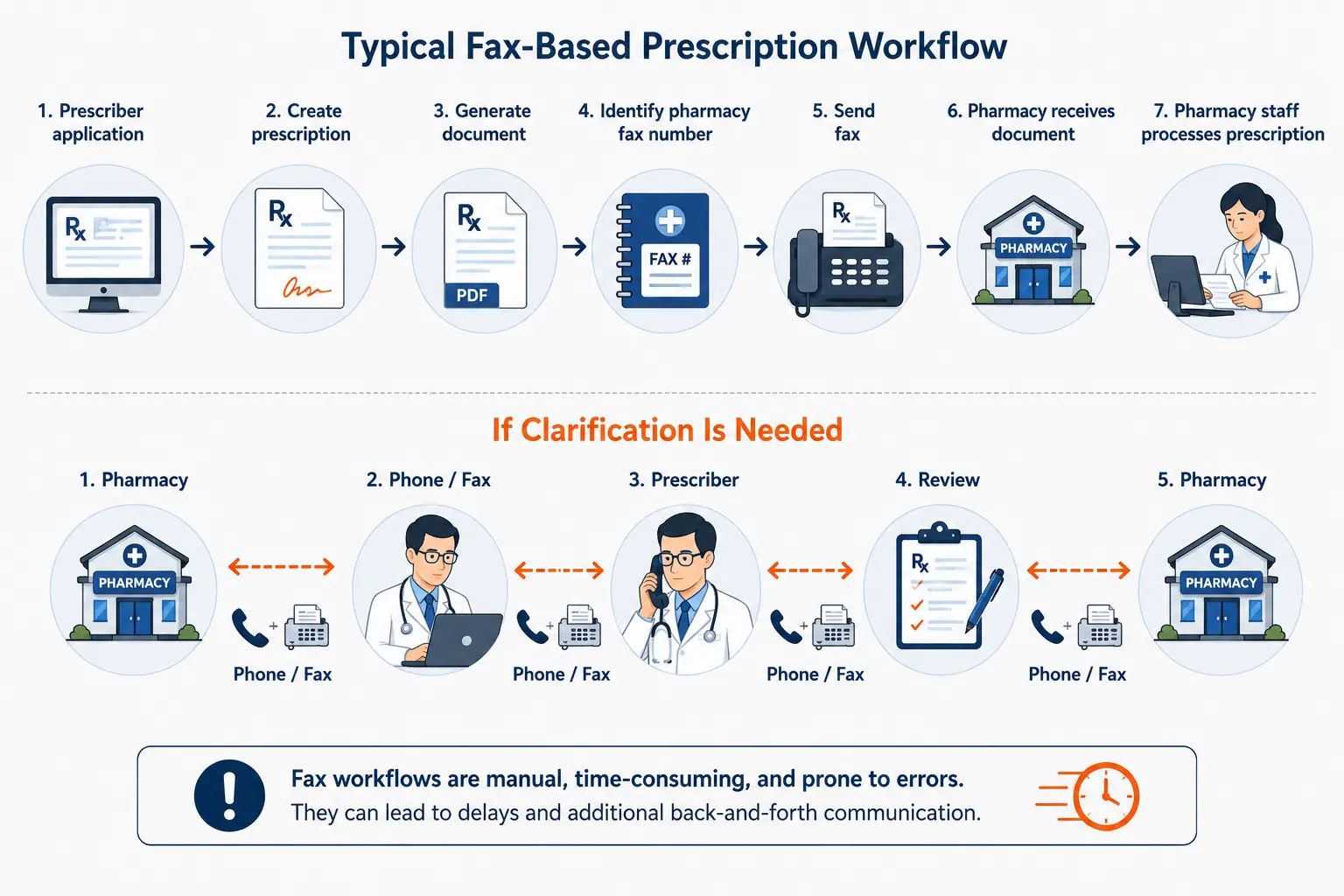
The application may have little visibility into the complete communication cycle.
Electronic prescribing workflow
An e-prescribing workflow can instead look like:
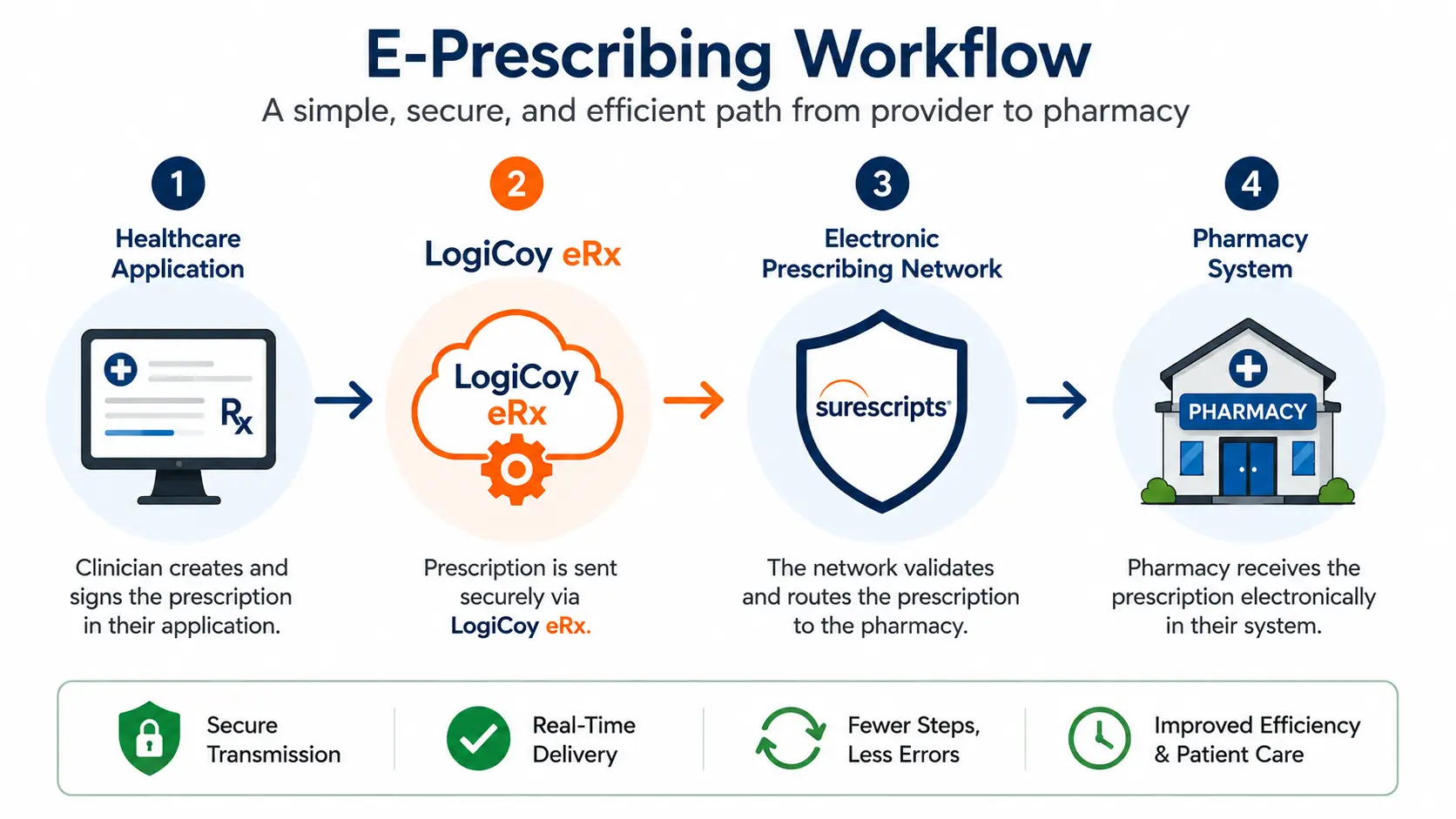
An e-prescribing workflow connects a healthcare application to the pharmacy through LogiCoy eRx and an electronic prescribing network
Prescription information is exchanged as structured data. When the pharmacy needs to communicate with the prescriber, applicable electronic transactions can support the response workflow.
This is the fundamental difference:
Fax is primarily a document-transmission workflow. Electronic prescribing is a structured, system-to-system transaction workflow.
The Hidden Cost of Fax: Maintaining Pharmacy Fax Numbers
One of the less obvious costs of fax-based prescribing is pharmacy directory management.
A fax-based application needs accurate information about where the prescription should be sent. Depending on the implementation, that can mean maintaining:
- Pharmacy name
- Pharmacy location
- Pharmacy phone number
- Pharmacy fax number
- Pharmacy identifiers
- Pharmacy operating status
- Other routing information
That information can change over time. Pharmacies can change locations, change contact information, open or close locations, or change operating status. A locally maintained directory can therefore become another operational responsibility for the healthcare application.
Surescripts provides pharmacy directory capabilities and describes its network as providing verified, accurate pharmacy contact information and pharmacy-selection functionality.
With LogiCoy eRx, the application can use the platform’s pharmacy capabilities and the Surescripts ecosystem instead of maintaining its own directory of pharmacy fax numbers for electronic prescription routing.
That means the application team can focus on its core healthcare workflow rather than building a separate pharmacy fax-directory infrastructure.
Key takeaway: A healthcare application using fax-based prescribing may need to maintain pharmacy fax information. With an e-prescribing platform like LogiCoy eRx, pharmacy directory and routing capabilities can be provided through the electronic prescribing ecosystem instead.
What Electronic Prescribing Adds Beyond Fax
Electronic prescribing is not simply a faster way to send the same document. It enables structured prescription workflows between participating systems.
Structured prescription data
An electronic prescription can contain structured information that can be processed by software instead of requiring a pharmacy employee to interpret a faxed document.
Machine-to-machine processing
The prescribing application and receiving pharmacy system can exchange prescription information electronically.
Electronic prescription-related workflows
The broader e-prescribing ecosystem supports defined transactions for workflows such as:
- New prescriptions
- Prescription changes
- Renewal requests
- New prescription requests
- Fill/status notifications
- Prescription cancellations
- Other prescription-related communication
Surescripts describes transactions including NewRx, RxFill, RxChange, RxRenewal, NewRxRequest, CancelRx and RxTransfer within its broader e-prescribing ecosystem.
These capabilities illustrate an important difference between fax and electronic prescribing: the electronic model can support a prescription lifecycle, not simply the delivery of a document.
Prescriber-pharmacist collaboration
For example, a pharmacist may need clarification about a prescription or want to suggest a change. Surescripts describes RxChange as an electronic workflow for pharmacist-prescriber communication.
The goal is to keep that interaction inside the prescription workflow rather than forcing staff to rely on separate phone and fax communications.
Why Are Healthcare Organizations Still Using Fax?
If electronic prescribing provides these advantages, why does fax continue to exist?
There is no reliable current national statistic that establishes what percentage of U.S. prescriptions are still sent by fax. A prescription not sent electronically could instead be handled by fax, telephone, paper, a pharmacy portal, or another workflow.
The continued use of fax can nevertheless be explained by several practical factors.
Legacy applications
Some healthcare applications were designed around document generation and fax transmission before modern API-based interoperability became common.
Existing operational workflows
Staff may already understand how to select a pharmacy, locate its fax number, send the prescription, and follow up if necessary.
Integration cost
Replacing a fax workflow with standards-based e-prescribing requires more than replacing a fax service. The application may need electronic transaction processing, pharmacy connectivity, testing, security, certification, and ongoing maintenance.
Perceived universality
Fax has historically been attractive because it was widely available across healthcare organizations.
Exceptions and fallback workflows
Fax can remain appropriate in specific situations where electronic transmission is unavailable or where applicable rules permit an alternative method.
The objective should therefore not be to eliminate fax regardless of circumstances. The better objective is to make standards-based electronic prescribing the primary workflow where it is appropriate, while retaining alternative communication methods when genuinely required.
Who Should Consider Replacing Fax With an eRx API?
Replacing fax with an electronic prescribing platform is particularly relevant for healthcare software companies that want prescribing to be part of their core application workflow. Healthcare applications can use an eRx API to add electronic prescribing without building the underlying pharmacy connectivity themselves. See how LogiCoy supports EHR and e-prescribing API integration.
EHR vendors
An EHR can integrate electronic prescribing directly into its clinical workflow instead of generating prescription documents for fax transmission.
Telehealth platforms
Telehealth applications can provide electronic prescribing without requiring the platform to maintain a separate directory of pharmacy fax numbers.
Digital health companies
Digital health applications can make prescribing part of an integrated patient and provider experience.
Healthcare SaaS vendors
Healthcare software companies can add e-prescribing without building an entire pharmacy connectivity and transaction infrastructure themselves.
Pharmacy technology vendors
Applications supporting pharmacy workflows can use standardized electronic communication to improve collaboration with prescribers.
Healthcare applications with legacy fax workflows
An organization that already has a working fax-based prescription workflow may be able to modernize the transmission and communication layer without replacing its entire application.
Explore how LogiCoy eRx APIs support integration for these use cases, or visit the vendor portal to evaluate the developer sandbox.
How to Replace Fax-Based Prescriptions With an eRx API
Replacing fax does not necessarily require rebuilding the entire healthcare application. A practical migration can be approached in stages.
- Map the existing fax workflow. Identify how prescriptions are created, how pharmacies are selected, where fax numbers are stored, how prescriptions are transmitted, and how failures or follow-up requests are handled.
- Identify the electronic workflows you need. Determine which prescription workflows your application actually requires, such as new prescriptions, prescription history, renewal workflows, prescription changes, cancellations, or notifications.
- Replace manual pharmacy fax selection. Move pharmacy selection from a locally maintained fax-number directory to the pharmacy capabilities available through your eRx platform.
- Integrate the eRx API. Keep the patient, provider, and clinical workflows inside your application while using the eRx API for electronic prescription connectivity.
- Implement electronic responses. Where applicable, support the electronic responses and prescription-related workflows required by your application.
- Test in a sandbox. Validate prescription creation, patient and prescriber information, pharmacy selection, medication information, SIG, quantities, refills, transaction responses, and error handling before production deployment. Visit the LogiCoy developer sandbox to begin testing.
- Complete production onboarding. Work through the eRx platform’s production onboarding, testing, and connectivity requirements.
- Gradually reduce fax dependence. During migration, organizations can maintain appropriate legacy workflows while validating electronic prescribing. Once the electronic workflow is established, fax can be retained only where it is still necessary.
Why Use an eRx API Instead of Building E-Prescribing Connectivity Yourself?
At first glance, replacing fax may seem like a simple API project. In practice, electronic prescribing involves an ecosystem of standards, transaction types, pharmacy connectivity, directory information, testing, security, certification, network requirements, and ongoing operational maintenance.
A healthcare software vendor building its own solution may need to address:
- NCPDP standards
- Transaction construction and validation
- Pharmacy directory and routing
- Network connectivity
- Prescription transaction responses
- Error handling
- Security
- Testing and certification
- Production onboarding
- Monitoring
- Standards changes and ongoing maintenance
An eRx API can provide an abstraction layer between the healthcare application and that underlying complexity. The application continues to own the user experience and clinical workflow while the eRx platform provides the electronic prescribing capabilities and connectivity.
Learn more about LogiCoy’s integration approach or explore application integration services.
How LogiCoy eRx Helps Replace Fax-Based Prescribing
LogiCoy eRx provides REST-based eRx APIs and FHIR R5 APIs for healthcare software integration. The platform is designed for healthcare software vendors including EHR vendors, telehealth platforms, and digital health companies.
With LogiCoy eRx, developers can integrate e-prescribing capabilities through REST APIs rather than building a fax-based pharmacy communication workflow. LogiCoy’s current FHIR R5 implementation provides a standards-based interface with API endpoints and workflows for:
- Clinician
- Patient
- Pharmacy
- Practice
- Prescription
- DrugSearch
- Notification
- ServiceLocation
- RxChange
- RxHistory
- RxRenewal
The published LogiCoy FHIR implementation supports both read and write operations and RESTful FHIR search capabilities. Learn more in LogiCoy eRx Adds FHIR R5 APIs for Faster ePrescribing Integration.
Also, LogiCoy has SDKs for major programming languages : Explore LogiCoy eRx SDKs for Java, Python, Node.js, C#, Go, Kotlin and PHP.
A platform built for healthcare integration
LogiCoy’s eRx integration offering is built on its existing electronic prescribing platform rather than being a separate greenfield prescribing implementation. LogiCoy also provides a vendor portal and sandbox environment for developers to begin integration and test workflows.
The platform is ONC certified and Surescripts certified, and supports electronic prescribing for controlled substances under applicable requirements.
LogiCoy eRx by the Numbers
The following numbers describe the LogiCoy platform and the broader e-prescribing ecosystem.
- 160+ REST APIs for integrating the entire e-Prescribing workflow
- 50+ FHIR APIs for standards based integration.
- 30.5 billion health-intelligence transactions were exchanged through the Surescripts network in 2025.
- 2.32 million healthcare professionals and provider organizations were connected to the Surescripts network in 2025.
- 2.64 billion e-prescriptions were filled through Surescripts in 2025.
- 32.9 million RxChange transactions were processed through Surescripts in 2025.
The Surescripts statistics demonstrate the scale of the electronic prescribing ecosystem. They are not claims about LogiCoy’s own transaction volume.
Fax vs. eRx APIs: When to Use Which
| Capability | Fax-based prescription workflow | eRx API-based workflow |
|---|---|---|
| Prescription transmission | Document or image | Structured electronic transaction |
| Pharmacy selection | Requires pharmacy contact information | Uses electronic pharmacy directory/routing capabilities |
| Pharmacy fax-number maintenance | Application may need to maintain fax numbers | Not required for electronic prescription routing |
| Data entry at pharmacy | May require manual interpretation and entry | Structured data can be processed electronically |
| New prescriptions | Fax document | Electronic NewRx workflow where supported |
| Prescription changes | Phone/fax/manual workflow | Electronic RxChange workflow where supported |
| Renewal workflow | Phone/fax/manual workflow | Electronic renewal workflow where supported |
| Prescription cancellation | Phone/fax/manual workflow | Electronic CancelRx workflow where supported |
| Fill/status communication | Separate/manual communication | Electronic workflow where supported |
| Machine-readable data | No | Yes |
| Two-way prescription communication | Limited | Defined electronic transactions where supported |
| Application integration | Document/fax integration | API integration |
| Pharmacy connectivity | Application-dependent | eRx platform/network connectivity |
| Scalability | Increasingly manual as volume grows | Designed for system-to-system processing |
Fax can remain appropriate for specific exceptions and permitted alternative workflows. However, if a healthcare application routinely generates prescriptions, maintains pharmacy fax numbers, relies on manual pharmacy communication, or needs scalable two-way prescription workflows, an eRx API is generally the more appropriate architecture.
Standards and Compliance
- NCPDP SCRIPT – The major industry standard for exchanging electronic prescription and prescription-related transactions. SCRIPT Standard Version 2023011 is required as of January 1, 2028 under the current CMS/ONC regulatory framework.
- HL7 FHIR R5 – An HL7 standard for exchanging healthcare information electronically, including RESTful APIs, search capabilities, and interoperability mechanisms. LogiCoy provides FHIR R5 APIs as an interface to its e-prescribing platform.
- ONC HTI-1 Final Rule – Establishes requirements and updates for certified health IT, interoperability, information exchange, and related certification criteria.
- LogiCoy certifications – LogiCoy eRx is ONC certified and Surescripts certified, and supports electronic prescribing for controlled substances under applicable requirements.
Frequently Asked Questions
Is fax considered electronic prescribing?
No. CMS explicitly distinguishes fax transactions from electronic prescribing. Electronic prescribing involves secure electronic, computer-to-computer transmission of prescription data, while fax transmits a document or image.
Can prescriptions still be faxed to pharmacies?
Yes. Fax can remain permitted in certain circumstances depending on the prescription type and applicable federal and state requirements. However, fax transmission should not be confused with standards-based electronic prescribing.
What is the difference between fax and electronic prescribing?
Fax generally transmits prescription information as a document or image. Electronic prescribing exchanges structured prescription information between participating healthcare systems using standardized electronic transactions.
Does an e-prescribing application need to maintain pharmacy fax numbers?
Not for the electronic routing workflow provided through an eRx platform. An eRx platform can provide pharmacy directory and routing capabilities, allowing applications to select pharmacies without maintaining their own directory of pharmacy fax numbers.
What is NCPDP SCRIPT?
NCPDP SCRIPT is a major industry standard for exchanging electronic prescription and prescription-related information. SCRIPT Standard Version 2023011 is currently named in CMS/ONC regulations with a January 1, 2028 compliance date.
Can a healthcare application replace fax with an eRx API?
Yes. An EHR, telehealth platform, or other healthcare application can integrate an eRx API to replace fax-based prescription transmission with structured electronic prescribing workflows, while retaining its existing clinical and user-facing application.
