

Introduction
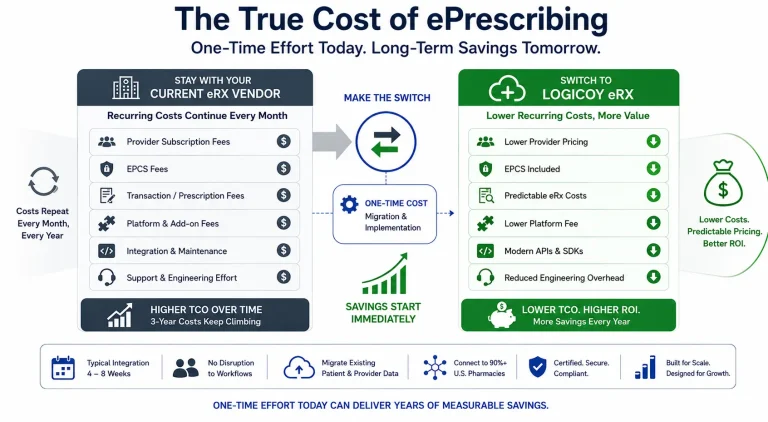
Evaluating ePrescribing costs means comparing the one-time cost of switching ePrescribing vendors against the recurring savings over the lifetime of the new relationship, not simply weighing switching cost against your current bill. For EHR vendors, telehealth companies, and digital health platforms with hundreds or thousands of prescribers, that reframing changes the decision entirely.
For an established EHR or healthcare software company, changing an electronic prescribing (eRx) vendor can feel like a decision that is easier to postpone than to make. Your existing integration works, your prescribers know the workflow, your application is already connected to the pharmacy network, and your engineering team has other priorities.
So even when another ePrescribing vendor offers better pricing, the first question is often: “Is the savings really worth the effort of switching?” It is a reasonable question. But there is another question that is often overlooked: how much will it cost to stay with your current eRx vendor for the next three to five years? Electronic prescribing is now a widely established part of U.S. healthcare workflows, with adoption supported by CMS and routed across the national Surescripts network, so the real comparison is one-time switching cost versus recurring savings over the life of the new eRx relationship.
Key Takeaways
- eRx TCO is more than the subscription fee. Include prescriber licensing, EPCS, usage, implementation, integration, migration, and engineering costs.
- Switching costs are typically one-time; vendor costs are recurring.
- Calculate your payback period by dividing switching costs by annual recurring savings.
- At scale, small per-prescriber differences can become significant annual expenses.
- A lower-cost eRx vendor should be evaluated on capabilities and TCO, not price alone.
- A typical LogiCoy integration takes approximately 4–8 weeks, depending on scope.
The Real Cost of ePrescribing Is More Than the Subscription Fee
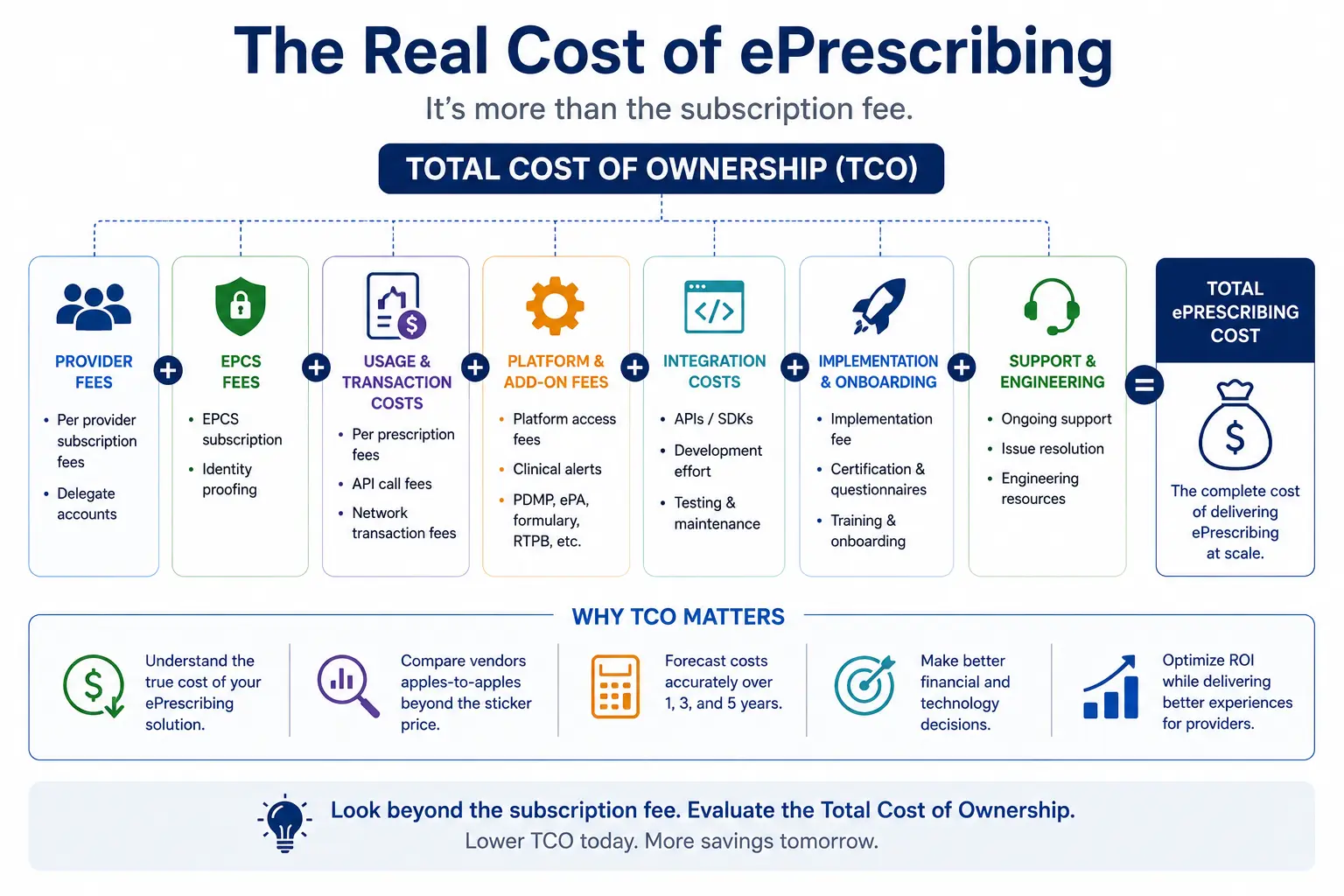
When evaluating an ePrescribing solution, organizations often begin with one number: cost per prescriber. But the actual cost of running ePrescribing can include many different components.
What actually drives your ePrescribing costs
- Prescriber subscription fees
- EPCS fees
- Prescription or transaction fees
- Platform fees
- API and integration fees
- Implementation and onboarding
- Additional clinical modules
- Identity proofing
- Data migration
- Engineering resources
- Ongoing support and maintenance
- Certification and compliance requirements
A vendor that appears inexpensive based on one pricing metric may not necessarily have the lowest Total Cost of Ownership (TCO). Conversely, a vendor with a slightly higher headline price may prove less expensive once all costs are considered. That is why an eRx vendor comparison should start with the total cost of operating ePrescribing, not just the advertised subscription.
What Is Total Cost of Ownership for ePrescribing?
For an EHR or healthcare software company, eRx TCO can be thought of as: Licensing + Usage + Platform Fees + Integration + Implementation + Ongoing Engineering and Support. The exact formula will vary by organization, but the principle is straightforward.
The six cost dimensions to quantify
- Recurring costs — what you pay every month or year.
- Usage-based costs — whether cost increases with prescription volume, API calls, or other transactions.
- Additional feature costs — whether EPCS, medication history, formulary, electronic prior authorization, or other capabilities are priced separately.
- Integration costs — the engineering effort required to integrate and maintain the platform.
- Implementation costs — setup, onboarding, certification, or identity-proofing fees.
- Migration costs — the effort required to move existing patients, prescribers, workflows, and integrations.
Once these numbers are combined, you get a much more realistic picture of the cost of your ePrescribing infrastructure.
The Hidden Cost of Staying With Your Current ePrescribing Vendor
Consider a hypothetical healthcare software company with 250 prescribers. Suppose its existing eRx solution costs approximately $55 per prescriber per month. That works out to 250 × $55 × 12 = $165,000 per year.
Now consider an eRx vendor offering EPCS-enabled prescribing at $35 per prescriber per month. That would be 250 × $35 × 12 = $105,000 per year — a difference of $60,000 per year.
A one-time migration expense does not eliminate that recurring difference. It simply delays the point at which the savings begin to accumulate. For example, if the total switching cost were $15,000, then $15,000 ÷ $60,000 = 0.25 years — a theoretical payback period of approximately three months. After that, the recurring difference becomes an ongoing economic benefit.
This is only an illustrative scenario. Actual eRx pricing varies by vendor, contract, prescriber count, features, transaction volume, and integration requirements. The important point is the methodology: compare the one-time cost of switching with the recurring cost difference over multiple years.
Switching Costs Are One-Time. Vendor Costs Are Recurring.
This is perhaps the most important concept when evaluating an eRx vendor change. Migration may require engineering resources, testing takes time, prescriber onboarding takes effort, and there may be implementation and identity-proofing activities. These costs are real — but most of them occur once. Your eRx subscription, prescriber fees, transaction costs, and other recurring charges continue every month.
| Cost component | Current Vendor | New Vendor |
|---|---|---|
| Annual recurring eRx cost | $165,000 | $105,000 |
| Annual difference | $60,000 | |
| One-time migration cost | $15,000 | |
| Year 1 net difference | $45,000 | |
| Year 2 net difference | $60,000 | |
| Year 3 net difference | $60,000 | |
| 3-year net savings | $165,000 |
Illustrative example only. Actual pricing and migration costs vary.
The $15,000 switching investment may look significant when viewed in isolation. But when compared against three years of recurring savings, the decision looks very different. This is why 3-year or 5-year TCO is often a more useful metric than the immediate migration expense.
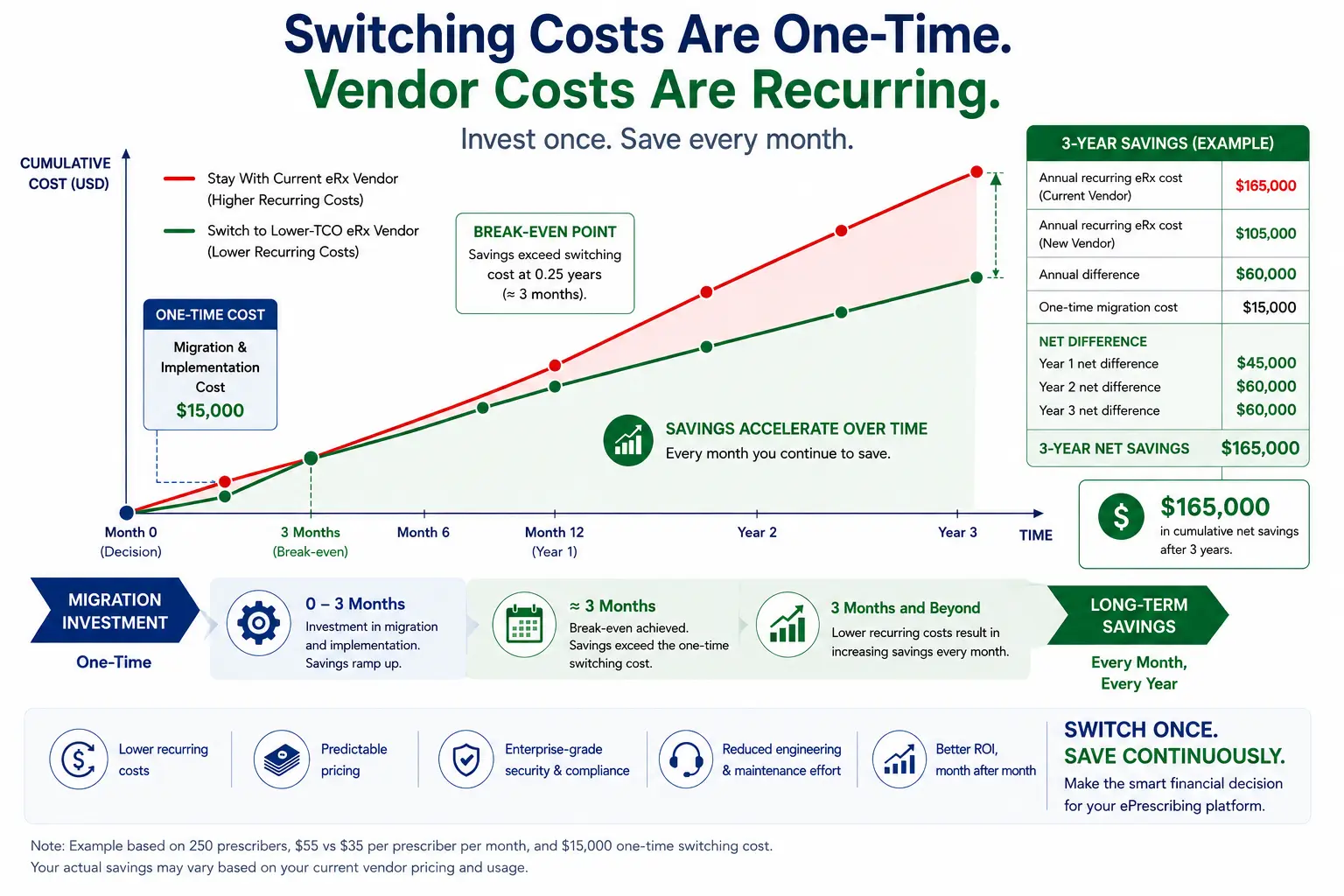 How a one-time switching cost is recovered by recurring eRx savings over time.
What Does an eRx Migration Actually Involve?
The phrase “switching ePrescribing vendors” can make migration sound more complicated than it needs to be. The actual effort depends on the existing architecture, the features being used, and how the new eRx platform is integrated.
A typical migration sequence
- Discovery and architecture review
- API integration
- Patient and prescriber data migration
- Prescription workflow integration
- EPCS setup and identity proofing
- Testing
- Certification and validation
- Production deployment
- Prescriber onboarding
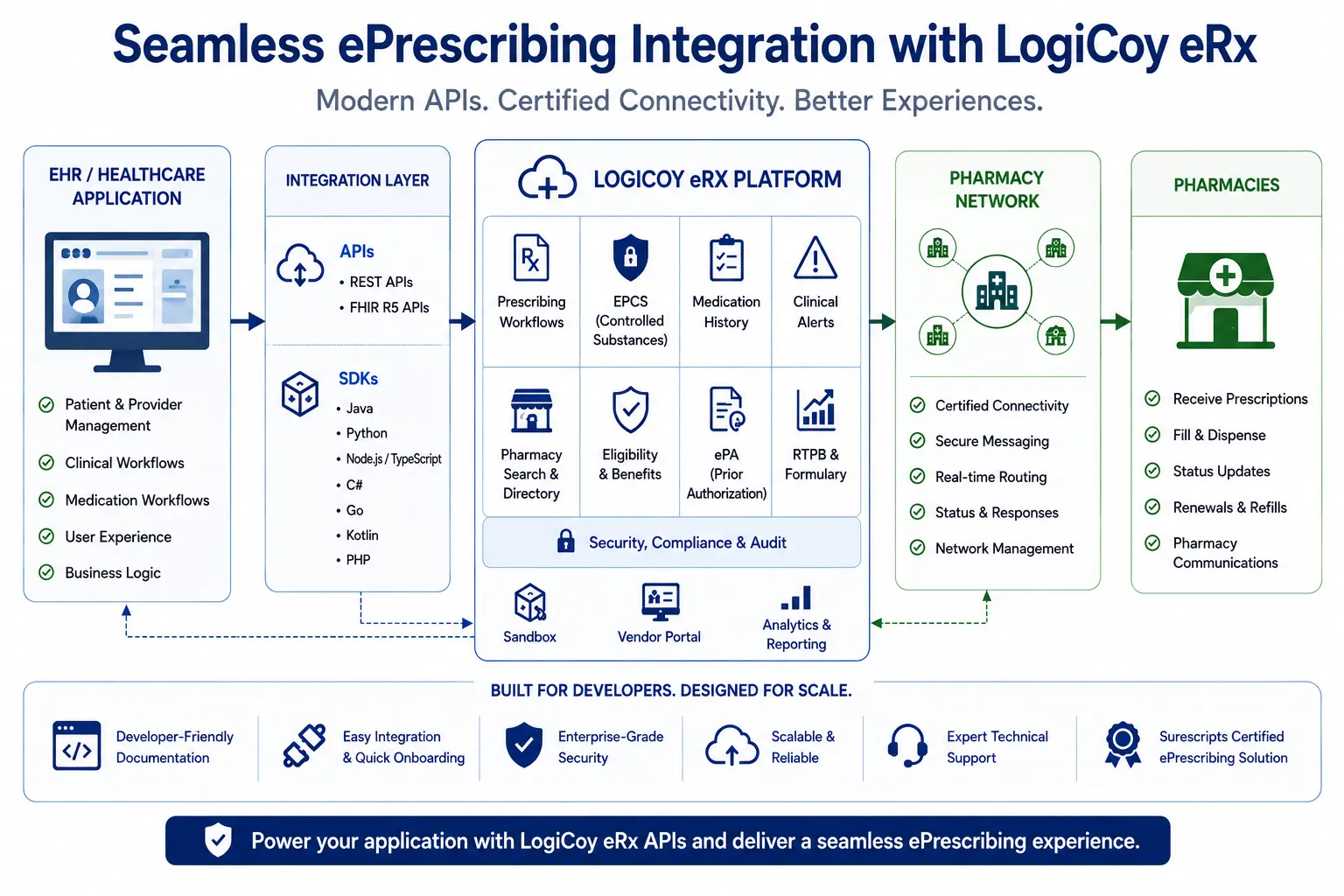
With an API-based platform, the healthcare application can continue to own its user experience while the eRx vendor handles the underlying prescribing infrastructure. LogiCoy eRx provides REST APIs and FHIR R5 APIs for EHR vendors, telehealth platforms, and healthcare applications, allowing organizations to integrate ePrescribing directly into their existing clinical workflows. Typical LogiCoy eRx integrations take approximately 4–8 weeks, depending on the scope of the implementation and the workflows being integrated.
You Don’t Have to Rebuild Your Entire ePrescribing Experience
One concern organizations often have is that changing eRx vendors means rebuilding the entire prescribing experience. An API-first approach can make that unnecessary.
What your application keeps
- Clinical user interface
- Patient workflow
- Prescriber workflow
- Prescription workflow
- Application-specific business logic
What the eRx platform provides
- Prescription transmission
- Pharmacy connectivity
- Medication data
- EPCS
- Medication history
- Clinical alerts
- Electronic prior authorization
- Prescription benefits
- Other ePrescribing workflows
LogiCoy eRx provides REST APIs as well as FHIR R5 APIs, allowing organizations to choose the integration approach that best fits their architecture. LogiCoy also provides SDKs for Java, Python, Node.js/TypeScript, C#, Go, Kotlin, and PHP to reduce repetitive integration work for development teams. You can explore the interfaces on the eRx integrations page.
What About Existing Patient and Prescriber Data?
Data migration is another important consideration, but an eRx migration does not necessarily mean starting from scratch. Existing patient and prescriber information can be imported as part of the migration process, which helps organizations transition to a new eRx platform while preserving the information required for their existing workflows.
Pharmacy directory information is provided through the underlying pharmacy network, while the migration can be planned to minimize disruption to prescribers. The goal should be a controlled transition, rather than forcing clinicians to completely change how they prescribe.
Don’t Compare eRx Vendors on Price Alone
Lower cost is valuable, but cost should never be the only consideration when selecting an ePrescribing platform. A better comparison looks at the full combination of pricing, capabilities, and effort.
| Evaluation Area | Questions to Ask |
|---|---|
| Prescriber pricing | What do we pay per prescriber? |
| Prescription volume | Does our cost increase with prescription volume? |
| EPCS | Is controlled-substance prescribing included? |
| API access | Are APIs included or separately priced? |
| Advanced capabilities | What do medication history, ePA, formulary, and RTPB cost? |
| Implementation | What are the one-time onboarding costs? |
| Integration | How much engineering work is required? |
| Migration | Can existing patient/prescriber information be migrated? |
| Certification | Who handles network and certification requirements? |
| Support | What technical support is included? |
| Scalability | What happens when the number of prescribers grows? |
| Predictability | Can we forecast our eRx costs accurately? |
The objective isn’t to find the lowest price. It is to find the lowest sustainable TCO for the capabilities your organization needs.
How eRx Pricing Can Affect Your Costs at Scale
A difference that looks small for one prescriber can become significant across a large prescriber base. Consider a hypothetical $20 per-prescriber monthly difference.
| Prescribers | Monthly Difference | Annual Difference | 3-Year Difference |
|---|---|---|---|
| 50 | $1,000 | $12,000 | $36,000 |
| 100 | $2,000 | $24,000 | $72,000 |
| 250 | $5,000 | $60,000 | $180,000 |
| 500 | $10,000 | $120,000 | $360,000 |
| 1,000 | $20,000 | $240,000 | $720,000 |
Illustrative calculation. Actual savings depend on the pricing of the current and new solutions.
This is where eRx pricing becomes a strategic technology decision rather than simply a software subscription. At 50 prescribers, the difference may be manageable. At 500 or 1,000 prescribers, the same pricing difference can become a substantial annual expense.
Don’t Forget the Cost of Engineering
For healthcare software companies, eRx isn’t only a licensing expense. It is also an engineering dependency.
Where engineering time goes
- API integration
- Authentication
- Error handling
- Prescription workflows
- EPCS workflows
- Testing
- Vendor-specific changes
- Production support
- Troubleshooting
- Maintaining integrations as requirements evolve
That engineering effort has an opportunity cost. Every sprint spent maintaining an eRx integration is a sprint that cannot be spent on other product priorities. This is particularly important for established EHR vendors that already have a mature product roadmap. The right question isn’t just “What does the eRx vendor charge us?” It is “What does this eRx relationship cost our business?” LogiCoy’s application integration services are designed to reduce that ongoing engineering burden.
A Lower eRx Price Shouldn’t Mean Fewer Capabilities
Cost optimization shouldn’t require organizations to sacrifice essential functionality. A modern ePrescribing platform may need to support a broad range of workflows.
Core prescribing
- New prescriptions
- Prescription changes
- Prescription cancellations
- Prescription renewals
- Refill workflows
Clinical workflows
- Medication history
- Drug interaction checking
- Allergy checking
- Duplicate therapy alerts
- Drug search
Advanced workflows
- Electronic prior authorization
- Formulary benefit requests
- Real-time prescription benefit
- Eligibility requests
Controlled substances
- EPCS
- Identity proofing
- Multi-factor authentication
- Required audit and compliance controls
LogiCoy eRx provides these capabilities through its standalone platform and API-based integration options, with REST and FHIR R5 interfaces available for healthcare application developers. The objective should therefore be lower TCO without compromising the ePrescribing capabilities your users need.
Three Ways to Use LogiCoy eRx
Different organizations have different requirements, so LogiCoy eRx can be adopted in three ways.
1. Standalone ePrescribing
Organizations that need a ready-to-use ePrescribing application can use LogiCoy eRx as a standalone platform. Current published pricing includes:
- $25 per prescriber/month for non-EPCS prescribing
- $35 per prescriber/month for non-EPCS + EPCS prescribing
- Unlimited prescriptions
- Two delegate accounts included per prescriber
- One-time platform setup and identity-proofing fee
For larger organizations, custom plans can also be evaluated based on their requirements.
2. Embedded eRx Experience
Organizations that want the prescribing experience within their own application can integrate eRx functionality into their existing workflows. This allows clinicians to use prescribing capabilities without requiring a separate application for every prescribing workflow.
3. ePrescribing APIs
EHR vendors, telehealth platforms, and healthcare software companies that want complete control over their user experience can integrate through LogiCoy eRx APIs. LogiCoy’s integration platform provides REST and FHIR R5 APIs, a sandbox environment and vendor portal, documentation, SDKs, and technical support throughout the integration process.
What Does LogiCoy eRx Cost?
LogiCoy’s pricing model is designed around predictable prescriber-based costs. For API customers, pricing can be tailored to the organization’s requirements and the capabilities being integrated.
For example, an API implementation may include a one-time implementation fee covering dedicated technical support through integration, testing, the Surescripts questionnaire and approval process, and identity proofing. Additional capabilities can be added based on requirements. This approach allows healthcare organizations to evaluate the eRx platform based on their actual use case rather than paying for capabilities they don’t need.
Pricing is subject to change and may vary based on customer requirements, volume, features, and commercial terms.
How to Calculate Your eRx Switching ROI
Before deciding whether to switch, calculate four numbers.
Step 1: Determine your current annual cost
Include prescriber fees + transaction fees + EPCS + platform fees + add-ons + other recurring costs.
Step 2: Estimate your new annual cost
Include prescriber fees + transaction fees + EPCS + platform fees + add-ons.
Step 3: Calculate annual recurring savings
Current annual cost − New annual cost = Annual recurring savings.
Step 4: Calculate the payback period
Total switching cost ÷ Annual recurring savings = Payback period. You can then calculate the three-year or five-year economic benefit.
When Should You Consider Switching eRx Vendor?
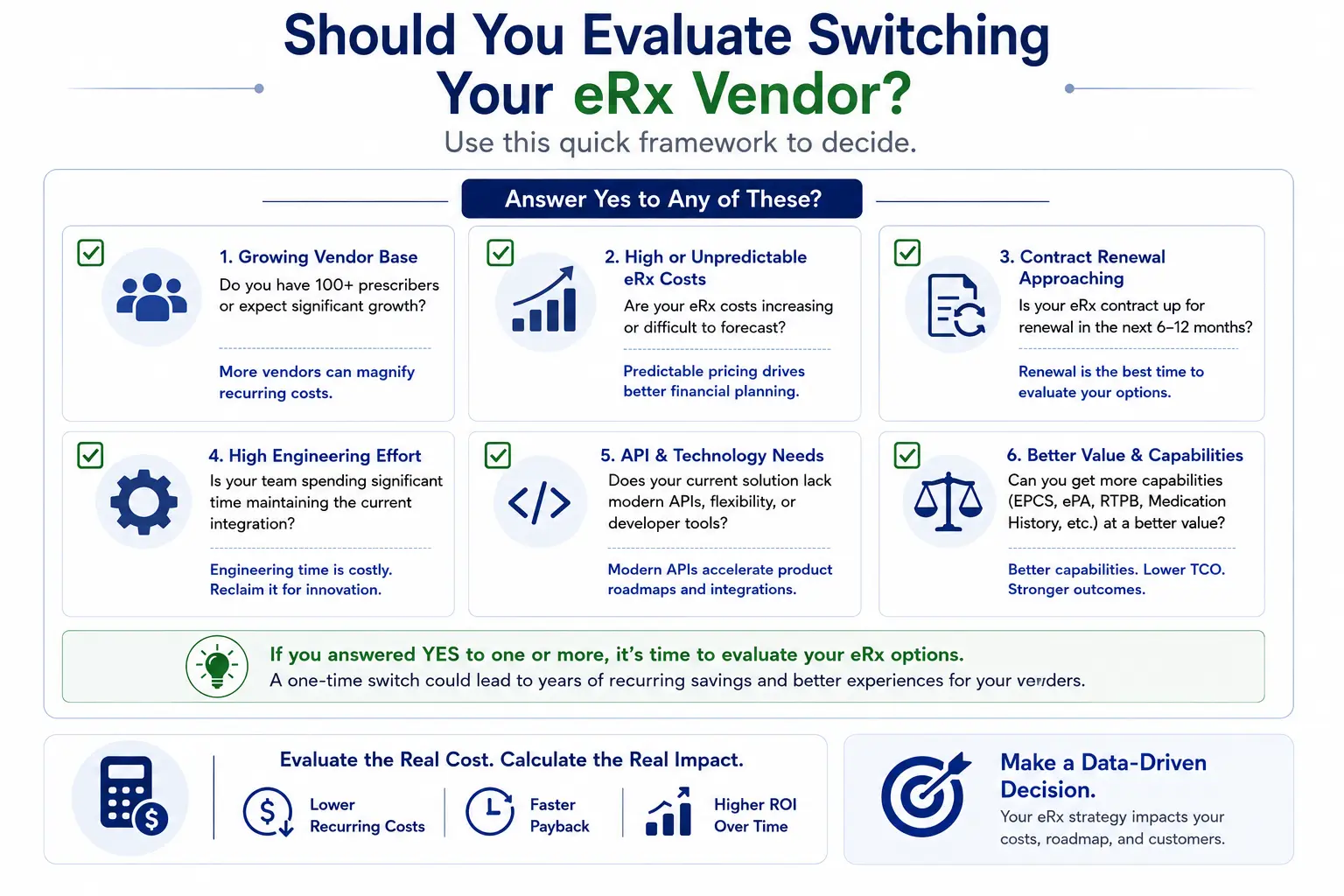
A vendor change may be worth evaluating when one or more of the following is true.
- Your eRx costs have increased significantly over time
- Your prescriber count has grown
- Your current pricing doesn’t scale well
- You are paying separately for capabilities you need
- Your current vendor’s API doesn’t meet your product requirements
- Your engineering team spends significant effort maintaining the integration
- You are planning a major EHR or platform modernization
- Your existing contract is approaching renewal
- You want more predictable eRx costs
- You are evaluating a multi-year technology strategy
You don’t necessarily need to wait until your current eRx contract expires. The best time to evaluate alternatives is often before renewal, when you have enough time to compare TCO and plan a controlled migration.
Five Questions for Your CIO, CTO, CFO, or Product Team
Before renewing your current eRx vendor, ask these five questions.
- What is our actual cost per prescriber? Not just the advertised subscription price — calculate the complete cost.
- How much will we spend over the next three years? Look beyond this year’s budget.
- How much would switching cost us? Include engineering, implementation, testing, migration, and deployment.
- How quickly would the migration pay for itself? Calculate the break-even point.
- What happens if we do nothing? Staying with an existing prescriber is also a decision, and it has a recurring cost.
The Best eRx Decision Is an Economic Decision, Not Just a Technical One
For many healthcare organizations, ePrescribing is infrastructure. It needs to be secure, reliable, compliant, scalable, and easy for clinicians to use. But it also needs to make economic sense.
When evaluating an eRx vendor, don’t look only at “What does it cost to switch?” Look at “What does it cost to stay?” Then compare the two over the next three to five years. A one-time migration effort may be justified if it produces meaningful recurring savings, reduces engineering overhead, improves pricing predictability, or provides capabilities that better support your product roadmap.
eRx by the Numbers
- 2.32 million healthcare professionals connected through the Surescripts network
- 30.5 billion transactions processed across the Surescripts network in 2025
- 4–8 weeks for a typical LogiCoy eRx integration
- 7 SDK languages supported: Java, Python, Node.js/TypeScript, C#, Go, Kotlin, and PHP
- $60,000 per year in illustrative annual recurring savings for a 250-prescriber organization with a $20 per-prescriber monthly cost difference.
Standards and Compliance
- Surescripts — the nationwide network that routes electronic prescriptions between prescribers and pharmacies.
- DEA EPCS requirements — the identity-proofing, two-factor authentication, and audit controls required for electronic prescribing of controlled substances.
- HL7 FHIR R5 specification — the interoperability standard behind LogiCoy eRx FHIR R5 APIs.
- ONC HTI-1 Final Rule — federal certification and interoperability requirements for health IT.
Frequently Asked Questions
What is the total cost of ownership (TCO) for ePrescribing?
ePrescribing TCO is the complete cost of running electronic prescribing, including prescriber subscription and EPCS fees, transaction and platform fees, API and integration costs, implementation and identity proofing, data migration, and ongoing engineering and support. It is a more accurate comparison metric than the advertised per-prescriber subscription price.
How do I calculate the ROI of switching eRx vendor?
Subtract your new annual eRx cost from your current annual cost to get the recurring savings, then divide the one-time switching cost by that annual savings to get the payback period. Multiply the annual savings over three to five years and subtract the switching cost to see the net long-term benefit.
How long does an eRx migration take?
A typical LogiCoy eRx integration takes approximately 4 to 8 weeks, depending on the scope of the implementation and the workflows being integrated. With an API-based platform, the application keeps its own user experience while the eRx vendor handles the underlying prescribing infrastructure.
Do I have to rebuild my prescribing experience when switching eRx vendors?
No. With an API-first approach, your application keeps its own clinical UI and prescription workflows while the eRx platform provides prescription transmission, pharmacy connectivity, medication data, EPCS, medication history, and other capabilities through REST and FHIR R5 APIs.
When is the best time to evaluate switching eRx vendors?
The best time to evaluate alternatives is often before your current contract renewal, when you have enough time to compare total cost of ownership and plan a controlled migration. A change is worth considering when costs have risen, prescriber counts have grown, or the current API no longer meets your product requirements.
Find Out What Your eRx Migration Could Save
Every healthcare organization has a different prescriber count, prescription volume, existing contract, feature set, and integration architecture, so there isn’t a single percentage that applies to everyone. Tell us your current eRx vendor, number of prescribers, approximate prescription volume, current pricing structure, EPCS requirements, and integration requirements, and we will help you estimate your potential eRx Total Cost of Ownership and switching ROI.
Find out how much you could save by switching to LogiCoy eRx and how long it could take to recover the cost of migration. Start on the eRx integrations page or request access to the sandbox and vendor portal.
