

Introduction
LogiCoy eRx is a Surescripts-certified electronic prescribing platform, and its OpenEMR eRx integration lets clinicians launch ePrescribing directly from an OpenEMR patient chart with patient information already synchronized. It is built for OpenEMR organizations that want to evaluate a different ePrescribing vendor without replacing their EHR.
If your organization already uses OpenEMR, changing your ePrescribing vendor may be easier than you think. LogiCoy has completed integration between OpenEMR and LogiCoy eRx that provides a practical way to connect an existing OpenEMR workflow with LogiCoy’s ePrescribing platform.
The important part is this: you do not have to replace OpenEMR to evaluate another ePrescribing vendor. For organizations currently using another eRx vendor, this creates an opportunity to reassess something often overlooked, whether the current ePrescribing solution still provides the right combination of functionality, integration, and cost.
Are You Paying Too Much for ePrescribing?
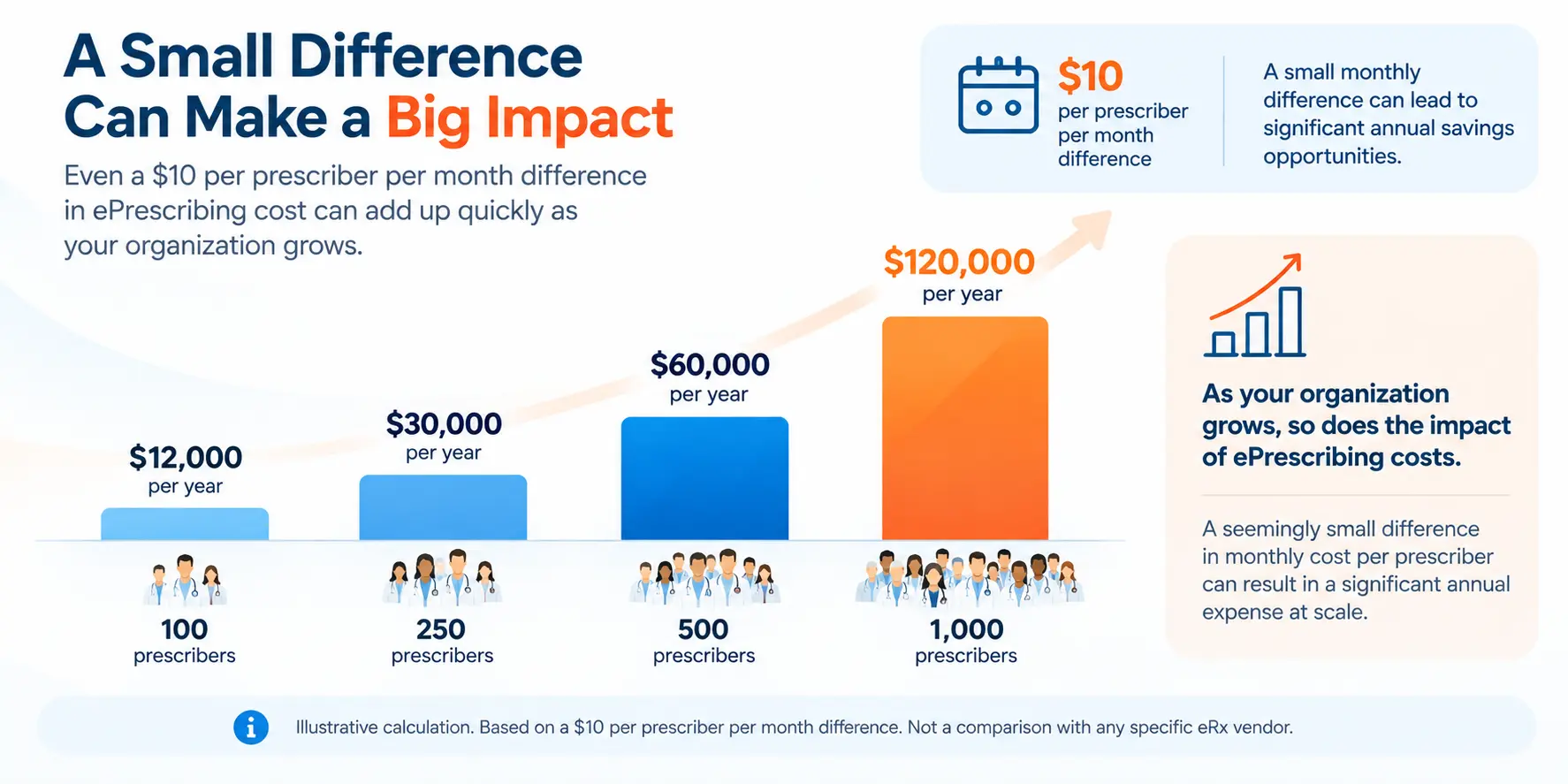
For a small medical practice, the difference between two ePrescribing pricing models may not appear significant. But consider an organization with hundreds or thousands of prescribers. Even a relatively small difference in recurring monthly cost can become a substantial annual expense.
For example, a difference of just $10 per prescriber per month represents:
- 100 prescribers: $12,000 per year
- 250 prescribers: $30,000 per year
- 500 prescribers: $60,000 per year
- 1,000 prescribers: $120,000 per year
These are illustrative calculations, not comparisons with any specific eRx vendor. The larger point is that ePrescribing costs become increasingly important as an organization grows. And this leads to an important question:
Are you continuing with your current ePrescribing vendor simply because switching appears difficult?
Keep OpenEMR. Change the ePrescribing Layer.
An ePrescribing migration does not necessarily mean replacing your EHR. OpenEMR can continue to be the system where clinicians manage patient records, while LogiCoy eRx provides the ePrescribing capabilities.
The basic concept is straightforward:
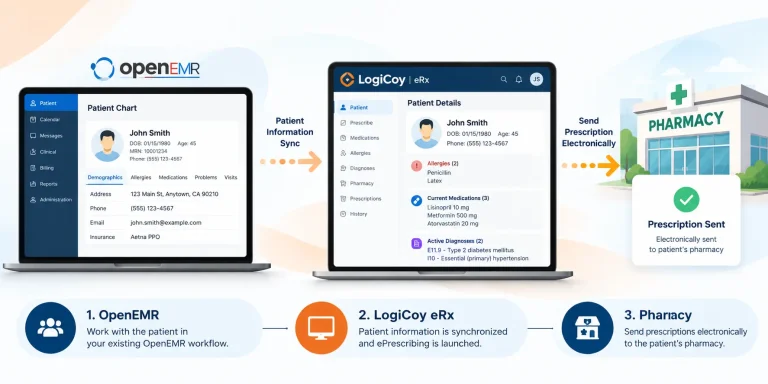
OpenEMR → LogiCoy eRx → Pharmacy
The current LogiCoy OpenEMR integration allows a clinician to launch LogiCoy eRx from the patient’s OpenEMR workflow. Patient information can be synchronized before the eRx session is launched, reducing the need to search for or re-enter patient information.
The integration currently supports synchronization of patient demographics and can also synchronize selected clinical information such as allergies, ICD-10-coded diagnoses, and medications, depending on configuration.
What Does the OpenEMR + LogiCoy eRx Workflow Look Like?
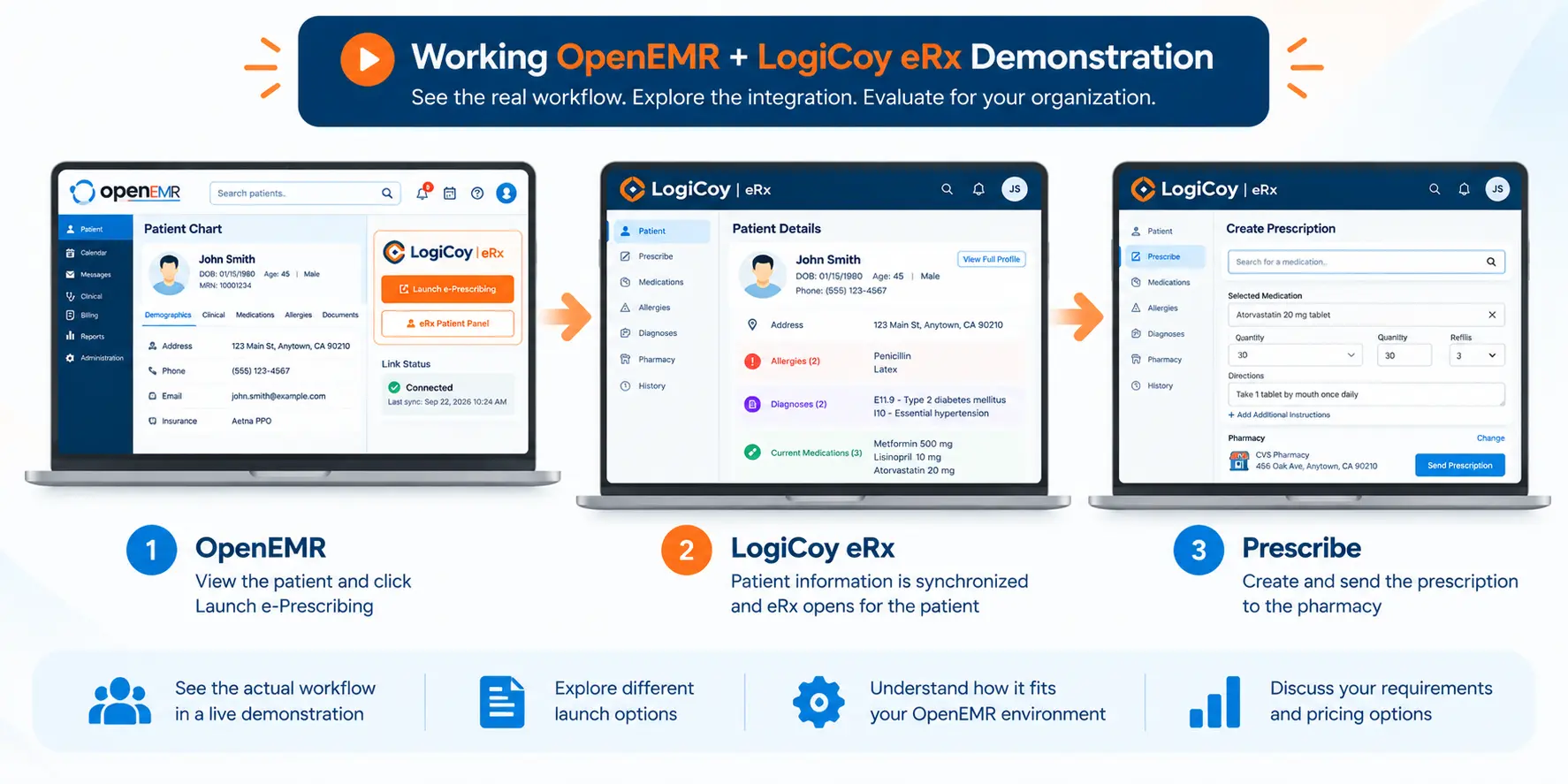
The objective of the integration is simple: let the clinician start from the patient they are already viewing in OpenEMR. The workflow can be summarized in four steps.
1. Open the patient in OpenEMR
The clinician works with the patient’s existing chart.
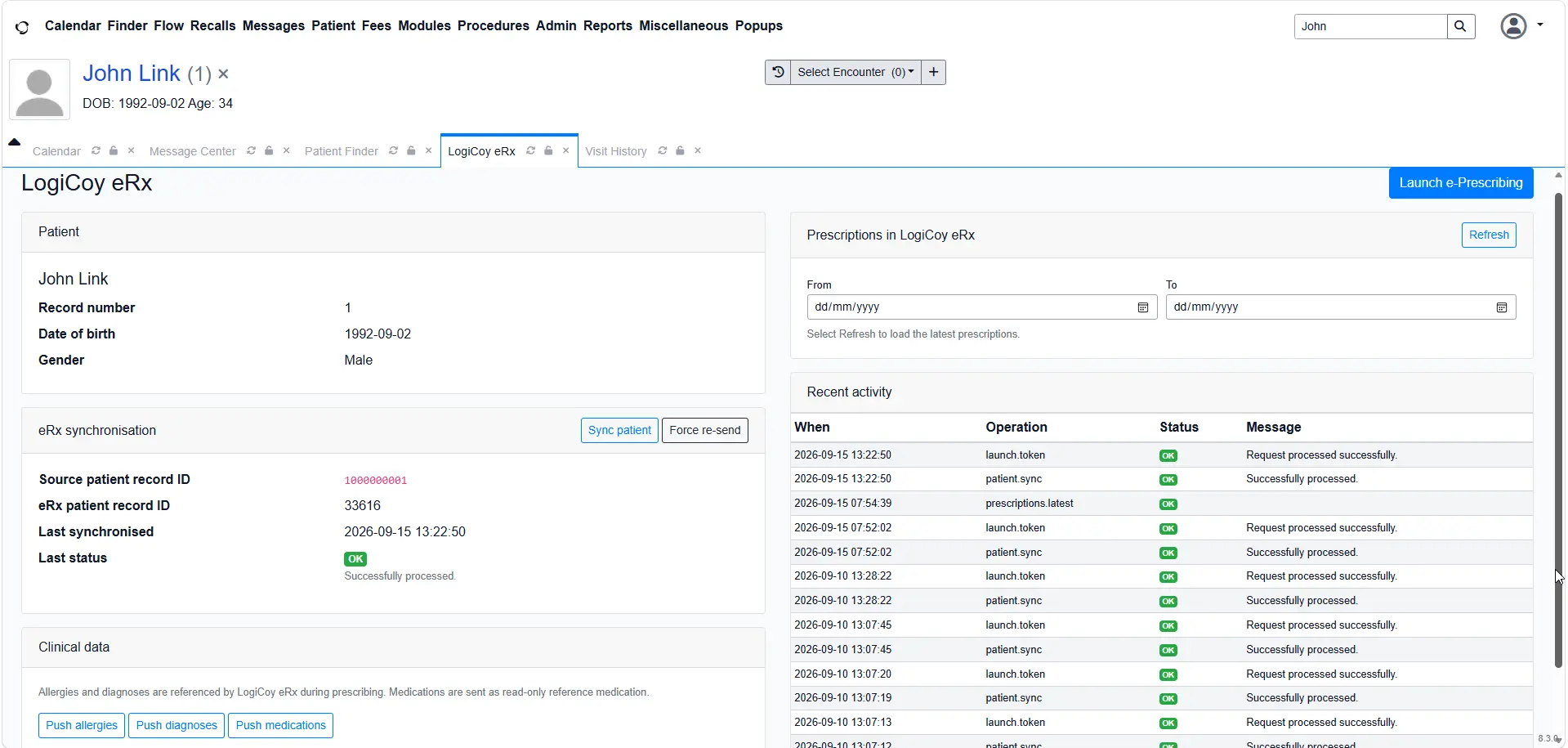
2. Click “Launch e-Prescribing”
The OpenEMR integration provides an option to launch ePrescribing for the selected patient.
3. Patient information is synchronized
The integration sends the relevant patient information to LogiCoy eRx.
4. Continue prescribing in LogiCoy eRx
LogiCoy eRx opens for that patient and the clinician can continue with the ePrescribing workflow.
The current implementation synchronizes patient demographics before launching LogiCoy eRx, so the clinician does not have to search for the patient or manually re-enter basic information.
Multiple Ways to Launch eRx
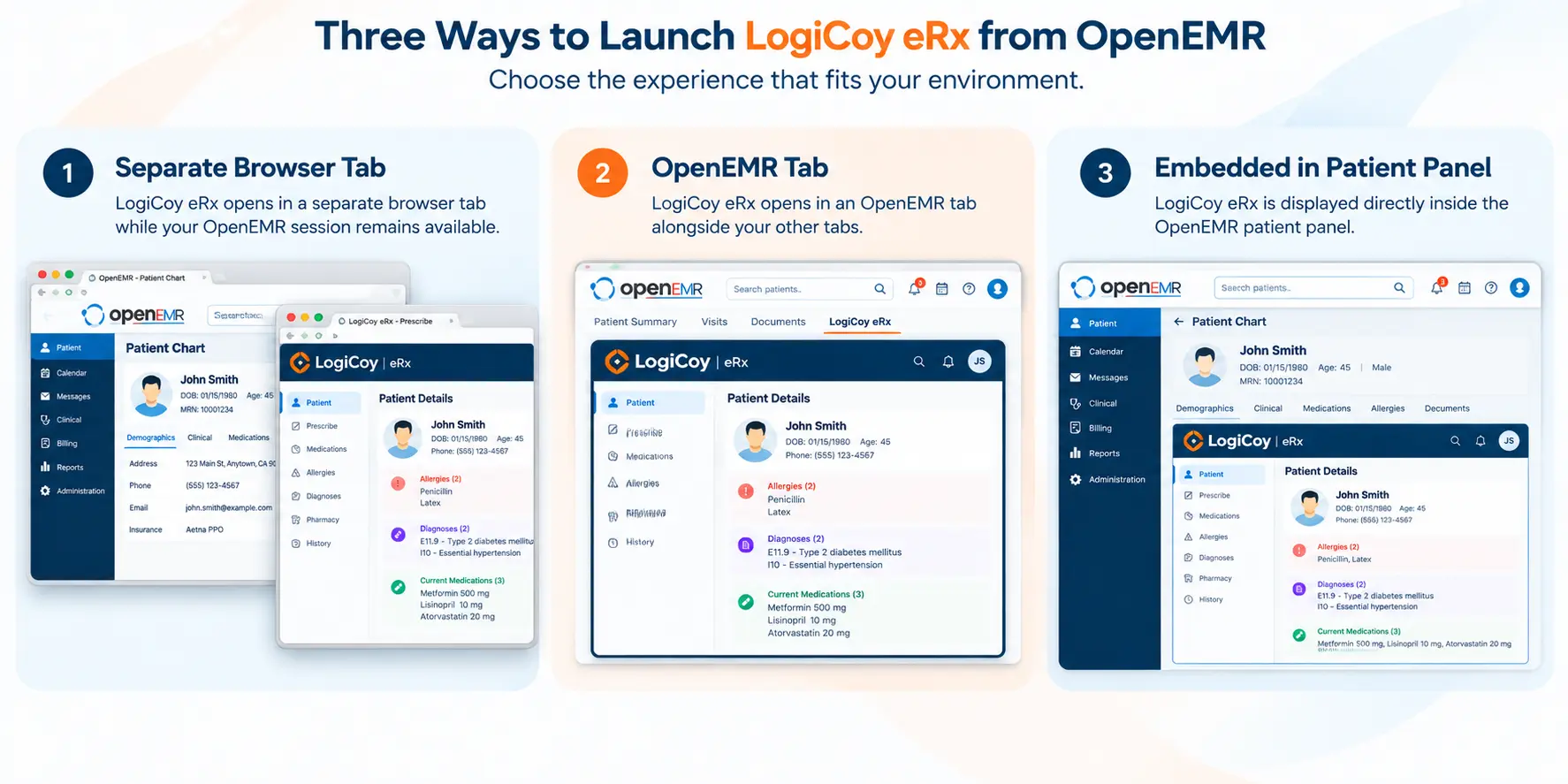
Different organizations have different preferences for how an external application should appear within their workflow. The current LogiCoy OpenEMR integration provides several options.
Separate Browser Tab
LogiCoy eRx can open in a separate browser tab while the clinician’s OpenEMR session remains available.
OpenEMR Tab
The eRx session can also appear in an OpenEMR tab.
Inline Inside the Patient Panel
Where the environment permits embedded content, LogiCoy eRx can be displayed inside the OpenEMR patient panel using an iframe.
This gives organizations flexibility in how they introduce LogiCoy eRx into their existing workflow. The important point is that organizations do not necessarily need to redesign their OpenEMR environment simply to evaluate LogiCoy eRx.
What Happens to Patient Information?
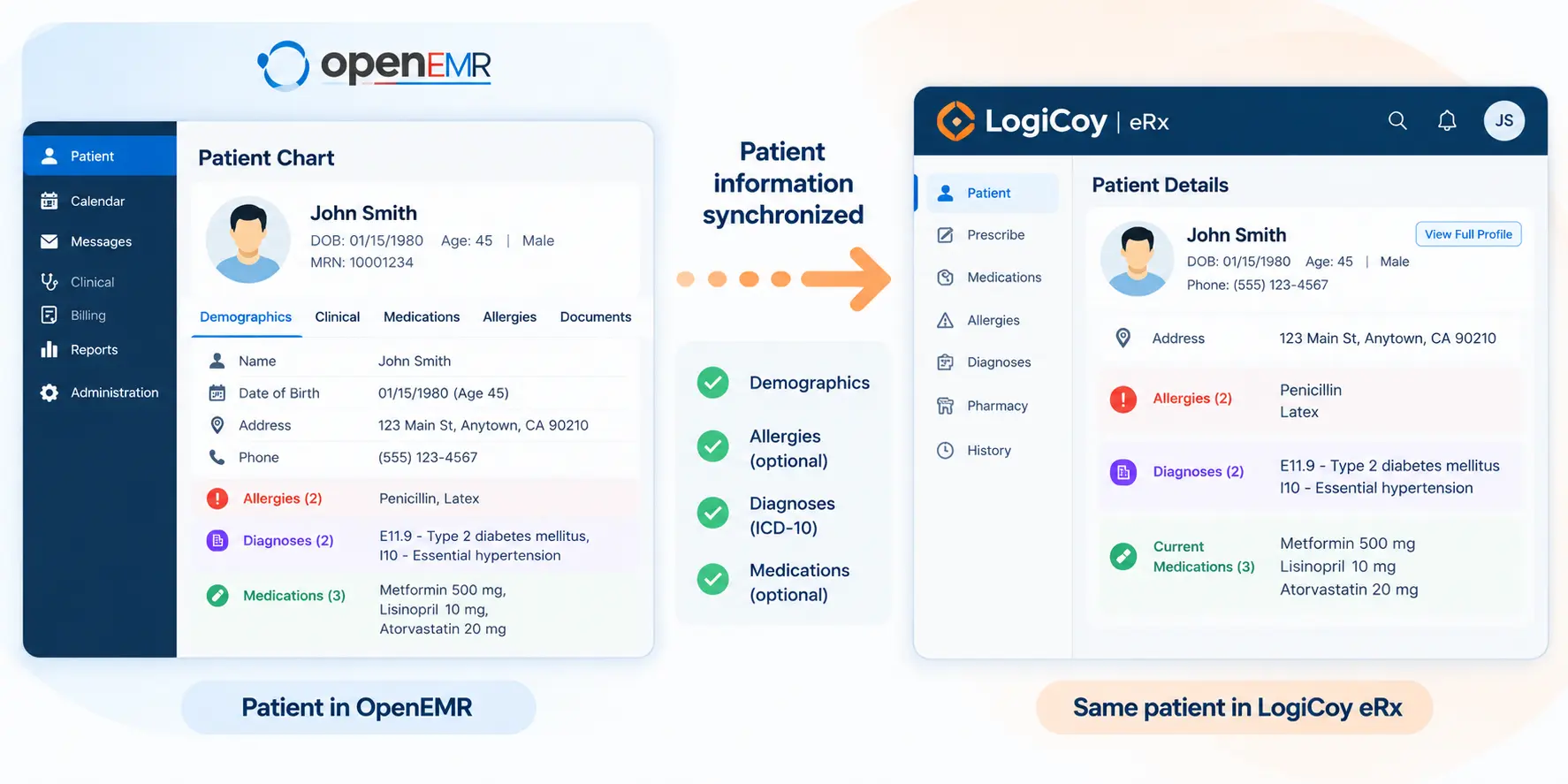
One of the concerns organizations often have when changing ePrescribing vendors is the patient workflow. Clinicians should not have to open another system, find the same patient, and manually recreate information that already exists in the EHR.
The current LogiCoy integration is designed to reduce this duplication. Patient demographics can be synchronized from OpenEMR to LogiCoy eRx. Depending on configuration, the integration can also synchronize:
- Allergies
- ICD-10-coded diagnoses
- Medications as reference information
This allows LogiCoy eRx to open with relevant patient information already available. The goal is simple: start with the patient, don’t start over with the patient.
The Bigger Question: What Are You Paying for ePrescribing?
The integration is only one part of the decision. For many organizations, the more important question is economic: how much does your current ePrescribing solution actually cost?
The subscription price is only one part of the total cost of ePrescribing. Organizations may also need to consider:
- Per-prescriber subscription fees
- EPCS costs
- Transaction fees
- Platform fees
- API or integration fees
- Implementation costs
- Identity proofing
- Engineering resources
- Support and maintenance
- Additional ePrescribing services
That is why it is useful to look beyond the advertised monthly price and calculate the overall Total Cost of Ownership (TCO). We explored this topic in more detail in our article on ePrescribing costs and total cost of ownership.
The key question is not simply “What does the eRx vendor charge per month?” It is: “What does ePrescribing actually cost our organization over the next several years?”
Small Differences Become Significant at Scale
Consider an organization with 500 prescribers. A $10 difference in monthly cost per prescriber represents $5,000 per month, or $60,000 per year. At 1,000 prescribers, that becomes $120,000 per year, and that cost continues year after year.
This is why ePrescribing pricing deserves attention from healthcare organizations and software companies operating at scale. The objective should not simply be to find the lowest price. Instead, organizations should compare cost, functionality, integration, support, and long-term TCO together.
But Isn’t Switching eRx Vendors Complicated?
This is often the first concern. Changing an ePrescribing vendor does require planning. Depending on the organization, there may be work involved in:
- Understanding the existing workflow
- Connecting the new eRx solution
- Mapping prescribers
- Mapping or synchronizing patients
- Testing prescription workflows
- Configuring EPCS where required
- Training users
- Moving to production
But it is important to distinguish between one-time migration effort and recurring vendor costs. Migration activities happen during the transition. Your ePrescribing subscription continues every month.
That is why the right question is not only “How much would it cost to switch?” It should also be: “How much are we spending by staying with our current vendor?” Our earlier article on ePrescribing costs and TCO explores this question in more detail.
LogiCoy eRx Is Built for Integration
LogiCoy eRx is designed to be integrated into healthcare applications and workflows. Organizations can use LogiCoy eRx as an application or integrate ePrescribing functionality through APIs, providing flexibility for organizations with different integration requirements.
For OpenEMR organizations, the current integration provides a practical way to connect OpenEMR with LogiCoy eRx without requiring the EHR itself to be replaced. For healthcare software companies and organizations that want a deeper integration, LogiCoy also provides REST APIs and FHIR-based integration capabilities through its eRx API integration options.
You Don’t Have to Make a Decision Based on a Diagram
One advantage we have today is that the OpenEMR integration is not just a conceptual architecture. We have a working OpenEMR environment with the LogiCoy integration installed and available for demonstration.
Organizations evaluating their ePrescribing options can see the workflow using a sample environment. A demonstration can show:
- The OpenEMR patient workflow
- The LogiCoy eRx launch experience
- Patient information synchronization
- The LogiCoy eRx patient screen
- Different ways of launching eRx
- The overall clinician experience
This makes it easier for an organization to evaluate whether the integration fits its existing OpenEMR environment.
Already Using Another eRx Vendor With OpenEMR?
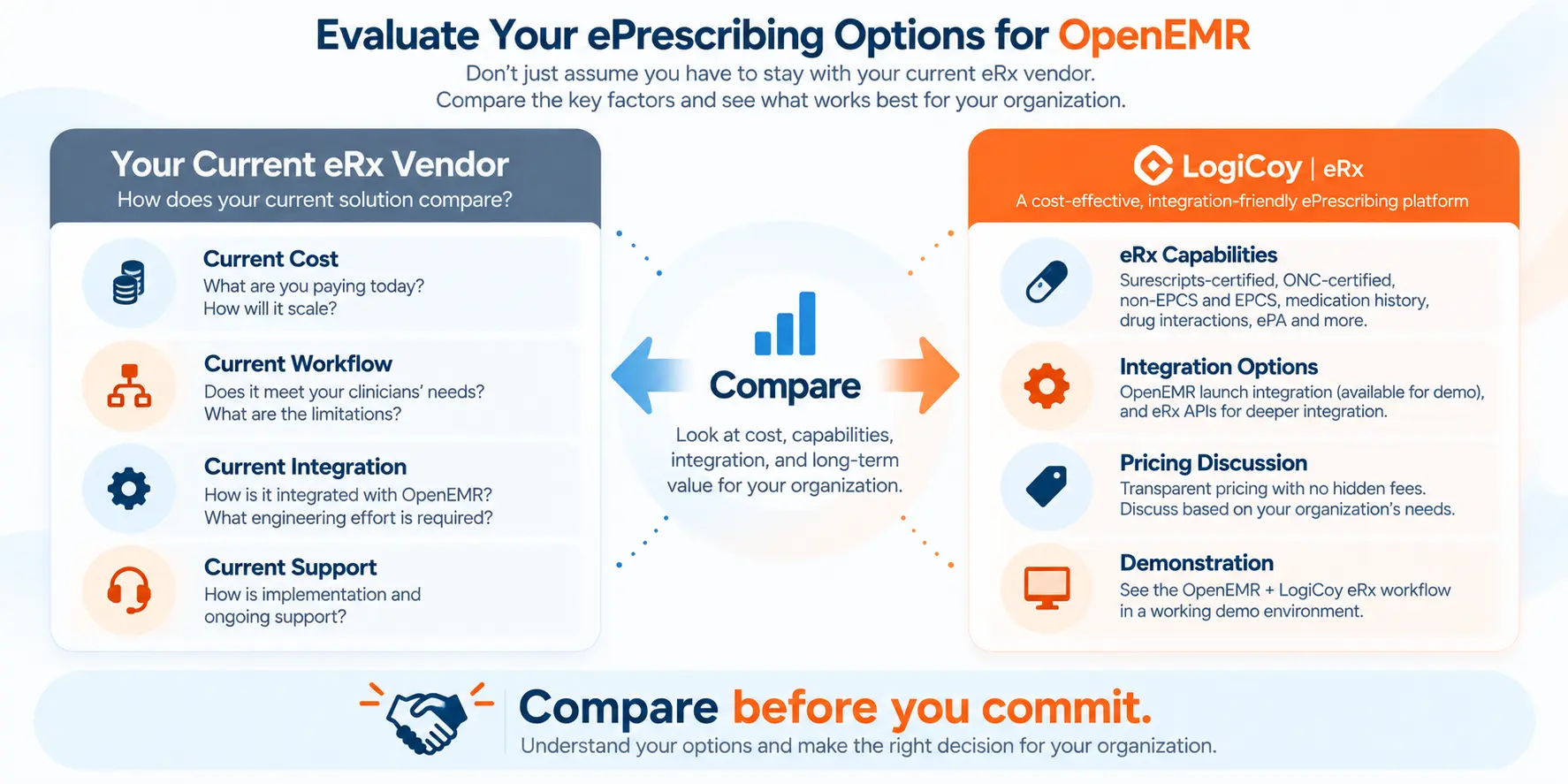
Then the question may not be whether OpenEMR can work with LogiCoy. The more important question may be: is your current ePrescribing vendor still the right fit for your organization?
If you are currently using another ePrescribing vendor with OpenEMR, it may be worth evaluating:
- How much are you paying today?
- How does that cost scale as your organization grows?
- Are you paying separately for capabilities you need?
- How much engineering effort does your current integration require?
- Does your current eRx workflow provide the experience your clinicians expect?
- What would it cost to stay with your current solution for the next three to five years?
You may find that the cost of continuing with your current solution deserves as much attention as the cost of switching.
Compare Before You Commit
If you are evaluating an alternative ePrescribing vendor, the first step does not have to be a migration. It can simply be a comparison. A useful comparison can include:
| Area | What to Evaluate |
|---|---|
| Prescribers | Number of active prescribers |
| EPCS | Whether EPCS is required |
| Pricing | Monthly and annual recurring costs |
| Prescription volume | Current and expected volume |
| Integration | Current and desired integration model |
| Workflow | Clinician experience |
| Support | Implementation and ongoing support |
| TCO | Total cost over multiple years |
At LogiCoy, we can discuss your current environment and demonstrate how the OpenEMR integration works. The objective is not simply to change eRx vendors. It is to determine whether your current ePrescribing solution continues to provide the right combination of functionality, integration, and economics for your organization.
OpenEMR eRx Integration by the Numbers
- 7 areas to evaluate before switching eRx vendors: prescribers, EPCS, pricing, volume, integration, workflow, and support.
- $120,000 per year illustrative recurring cost impact of a $10 monthly per-prescriber difference across 1,000 prescribers.
- 3 launch options in the current integration: separate browser tab, OpenEMR tab, and embedded patient panel.
- 2.32 million healthcare professionals connected through the Surescripts network that certified eRx platforms use.
- 30.5 billion transactions processed across the Surescripts network in 2025.
Standards and Compliance
- Surescripts — the nationwide ePrescribing network for routing electronic prescriptions to pharmacies.
- ONC e-Prescribing — federal guidance on electronic prescribing standards and interoperability.
- HL7 FHIR R5 — the interoperability standard used for deeper API-based healthcare integrations.
- OpenEMR — the open-source electronic health record and practice management system this integration connects with.
Frequently Asked Questions
Can I use LogiCoy eRx with OpenEMR?
Yes. LogiCoy has a working proof-of-concept integration that lets clinicians launch LogiCoy eRx from an OpenEMR patient workflow, with patient information synchronized before the eRx session opens.
Do I have to replace OpenEMR to change my eRx vendor?
No. OpenEMR can remain the system where clinicians manage patient records while LogiCoy eRx provides the ePrescribing layer, so you can evaluate an alternative eRx vendor without replacing your EHR.
What patient information is synchronized from OpenEMR to LogiCoy eRx?
The integration synchronizes patient demographics and, depending on configuration, can also synchronize allergies, ICD-10-coded diagnoses, and medications as reference information.
How can LogiCoy eRx be launched from OpenEMR?
LogiCoy eRx can open in a separate browser tab, in an OpenEMR tab, or embedded inside the OpenEMR patient panel where the environment permits embedded content.
Ready to Explore OpenEMR + LogiCoy eRx?
If you are an OpenEMR organization looking for an alternative ePrescribing vendor, we would be happy to demonstrate the LogiCoy OpenEMR integration. We can show you the current workflow, discuss your integration requirements, and help you understand the available eRx options and pricing.
Already using another eRx vendor? Let’s compare your current ePrescribing costs and requirements with what LogiCoy can offer. Request an OpenEMR eRx demo or talk to us about eRx pricing.
Keep your OpenEMR. Keep your clinical workflow. Explore a different approach to ePrescribing.
